Hey there, fellow data center folks—whether you’re building a new colo, upgrading an existing edge facility, or just trying to figure out why that raised floor tile creaks every time your junior tech walks by, today’s deep dive is for you. As a raised floor data center supplier who’s been on-site (and under-floor) for way too many deployments, I’ve seen so many projects go sideways because they skipped the “boring” load-bearing math for their access flooring. Let’s cut the jargon, talk real-world requirements, and why this isn’t just a “pick a tile that holds weight” checkbox. Raised Floor Data Center
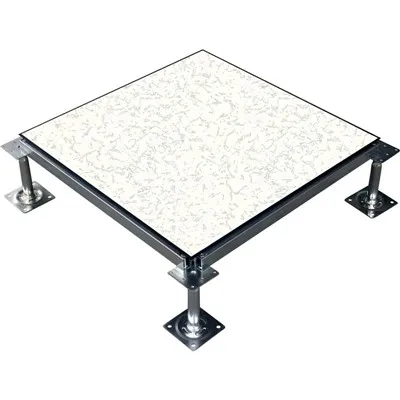
First off, let’s ground this in what raised floors actually do beyond just hiding cables and cooling lines. In 2024, data centers are pushing way more density than they used to—we’re talking 50kW+ racks, AI training clusters with liquid-cooled components, and backup power systems that weigh as much as a small car. The raised floor isn’t just a walkway for your maintenance team; it’s the skeleton supporting that gear, plus the load of the crew rolling servers, swapping PDUs, and even the occasional pallet of new hardware delivered at 2 a.m. Skip getting this right, and you’ll end up with cracked tiles, warped pedestals, or worse— a rack tipping mid-load test, costing you downtime, money, and way too many late-night panic calls.
Let’s break down the core load requirements, no stuffy industry handbook speak. First, there’s static load vs. dynamic load—you hear these terms all the time, but let’s make them tangible. Static load is the steady, dead weight of all the gear sitting on the floor, right? For a standard colo rack (around 10kW to 20kW), that’s roughly 1,500 to 2,500 lbs per rack. But cranked-up AI racks? We’re at 4,000 to 6,000 lbs per rack, plus the overhead of cable trays, cooling manifolds, and maybe a temporary storage cage for spares. Then there’s the “dead load” of the floor itself: pedestals, stringers, tiles—usually another 300 to 500 lbs total per square foot. Most of our customers forget to add that in, so don’t make that mistake.
Dynamic load is the fun (read: chaotic) part—this is the moving weight. Think techs rolling a 2,000 lbs server on a dolly, a forklift moving 10,000 lbs of batteries across the floor, or even a crew doing a rack install where everyone’s standing on a single tile at once. For most standard data centers, the minimum dynamic load we spec for is 2,000 lbs per square foot (lbs/ft²), but if you’re dealing with heavy equipment or frequent hardware swaps, you’re looking at 3,000 lbs/ft². We had a customer a year back who tried to use a standard 2,000 lbs/ft² system for a new edge facility that needed to handle pallet jacks; within six months, half the tiles along the receiving bay had hairline cracks and one pedestal had bent so bad it sagged 2 inches. That’s a $15,000 fix just for the floor, not including the downtime when they had to shut down a bay to repair it.
Then there’s concentrated load, which is the big one most people overlook. Concentrated load is the weight on a single small area—like a 1,000 lbs PDU sitting on one corner of a tile, or a rack’s mounting legs pressing down on two adjacent tiles. The industry standard minimum here is 10,000 lbs concentrated load per point, but for heavy-duty deployments, we bump that to 12,000 lbs, sometimes 15,000 lbs, for areas with liquid-cooled rack manifolds or big uninterruptible power supply (UPS) units that only rest on a few support points. I learned this the hard way early in my career—we installed a floor for a client with 8kW racks that didn’t meet concentrated load specs, and when they swapped to 12kW racks a year later, the mounting legs pushed through two tiles, fried a nearby fiber cable, and took out a 48-port switch. Ugh. Never again.
Wait, also—we can’t ignore the seismic and wind load factors, depending on where your data center is located. If you’re building in a zone with high earthquakes (like California or the Pacific Northwest) or frequent high winds (coastal areas like Florida), your load requirements go up. For seismic, we have to account for the floor moving and the gear shifting, so we spec pedestals with reinforced base plates and tiles that clip into stringers instead of just sitting loose. We did a project in Austin a few years back that needed to meet ICC seismic zone 4 standards, and the load rating ended up being 2,500 lbs/ft² static, not the standard 2,000. Small adjustment, but it meant the difference between passing and failing the pre-operational seismic test.
Now, how do suppliers like us (ahem) make sure you’re hitting these numbers? We don’t just sell tiles off a shelf—we do a site walk first, right? We measure the planned rack layout, check if there are any heavy components (UPS, generators, cooling units) that will be on the floor, ask how often they’ll be moving gear with dollies or pallet jacks, and factor in future expansion too. No one wants to have to rip up the floor in two years because they’re adding 10 more high-density racks. I always tell customers: spec for the next 5 years, not just today. Most of our projects use steel-core tiles for heavy-duty deployments, since they’re way sturdier than woodcore or calcium sulfate tiles. Wait, quick note: calcium sulfate tiles are cheaper, but they’re only good for low-density, low-traffic spaces—we only recommend those for small, non-critical edge facilities, not colos or core data centers.
Also, let’s talk about compliance. You might hear terms like BICSI, TIA-942, or ISO 27001 thrown around. Those aren’t just fancy acronyms—TIA-942 specifically outlines load requirements for raised floors, dividing data centers into tiers (Tier 1, Tier 2, Tier 3, Tier 4). Tier 4, the highest redundancy, requires a minimum static load of 2,000 lbs/ft², dynamic of 3,000 lbs/ft², and concentrated load of 10,000 lbs. We recently did a Tier 4 facility in the Northeast, and we spec’d 15,000 lbs concentrated load for the UPS bay because those units weigh 12,000 lbs total, sitting on four points. The pre-install audit passed with zero issues, and during the post-install load test, we rolled a 12,000 lbs test weight across the bay and not a single tile shifted. That’s the stuff you don’t want to wing.
Wait, another mistake we see customers make: not accounting for the finish on the tiles. If you’re using a conductive finish for ESD (electrostatic discharge) compliance, that can add a small amount of weight, but more importantly, it affects friction—so when techs roll servers, the tiles are less likely to slip. We always spec a high-friction conductive finish for critical areas, because a dolly slipping mid-server roll is a tripping hazard and can damage both the server and the floor.
Let’s circle back to that real-world example I mentioned earlier. The customer in Austin that tried to cut corners? They reached out to us after their floor failed, and we re-laid their floor with steel-core tiles, reinforced pedestals, and adjusted the load rating to meet seismic Zone 4 specs. The repair took three days, no downtime for their primary IT gear, and they’ve been good ever since. The moral? Don’t treat raised floor load requirements as an afterthought. It’s not just part of the construction—it’s part of the infrastructure that keeps your data center running.

If you’re in the middle of planning a data center, upgrading an existing facility, or just want to make sure your current floor can handle the next round of high-density racks, we’re here to help. We do free site assessments, walk through load calculations tailored to your specific gear and location, and provide customized solutions that fit your budget without cutting corners. No one likes dealing with floor failures or unexpected repairs, so let’s get this right the first time. Shoot us a message to start the conversation—we’ll make sure your raised floor is strong enough for whatever your data center throws at it, from AI clusters to late-night server swaps.
References
Waterproof Raised Access Floor Telecommunications Industry Association. TIA-942: Telecommunications Infrastructure Standard for Data Centers, 2017.
Building Industry Consulting Service International. BICSI Data Center Design Guide, 2022.
International Code Council. International Building Code (IBC) for Seismic and Wind Load Requirements, 2021.
Fineco Tech Co., Ltd.
As one of the most professional raised floor data center manufacturers and suppliers in China, we’re featured by quality products and good service. Welcome to wholesale customized raised floor data center made in China here from our factory. If you have any enquiry about cooperation, please feel free to email us.
Address: Wuyue Square, Wujin District, Changzhou, Jiangsu, China
E-mail: info@finecotech.com
WebSite: https://www.finecoglobal.com/
